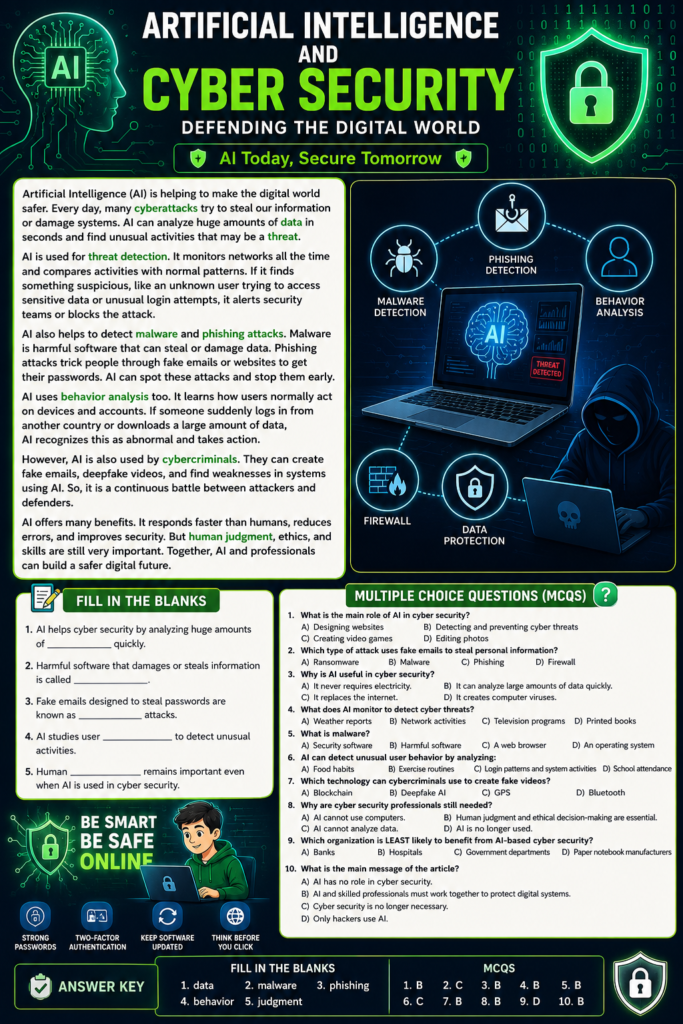
Artificial Intelligence and Cyber Security: Defending the Digital World
Artificial Intelligence (AI) has become one of the most powerful technologies in modern cyber security. Every day, millions of cyberattacks target computers, smartphones, banks, hospitals, schools, and government organizations. Because these attacks happen so quickly, human experts alone cannot detect every threat. AI helps by analyzing huge amounts of data in seconds and identifying unusual activities that may indicate a cyberattack.
One of the most important uses of AI in cyber security is threat detection. AI-powered systems continuously monitor networks and compare current activities with normal patterns. If AI detects suspicious behavior, such as an unknown user trying to access sensitive information or unusual login attempts, it immediately alerts security teams or blocks the attack automatically.
AI is also used to detect malware and phishing attacks. Malware is harmful software designed to damage or steal information from computers. Phishing attacks trick people into revealing passwords or financial details through fake emails or websites. AI can recognize hidden patterns in these attacks and stop them before they cause serious harm.
Another important application is behavior analysis. AI learns how users normally interact with devices and online accounts. If someone suddenly logs in from another country or downloads an unusually large amount of confidential data, AI recognizes this as abnormal behavior and takes action to protect the system.
However, AI is not only used by defenders. Cybercriminals also use AI to create more advanced attacks, such as generating realistic fake emails, creating deepfake videos, or automatically searching for weaknesses in computer systems. This makes cyber security a continuous battle between attackers and defenders using advanced technologies.
Despite these challenges, AI offers enormous benefits. It can respond to threats much faster than humans, reduce human errors, and improve the overall security of digital systems. However, AI should always work together with skilled cyber security professionals because human judgment, ethics, and decision-making remain essential in protecting digital information.
As technology continues to evolve, understanding both AI and cyber security will become one of the most valuable skills for future professionals. Students who develop knowledge in these fields today will be better prepared to build safer digital communities tomorrow.
Fill in the Blanks
1. AI helps cyber security by analyzing huge amounts of __________ quickly.
2. Harmful software that damages or steals information is called __________.
3. Fake emails designed to steal passwords are known as __________ attacks.
4. AI studies user __________ to detect unusual activities.
5. Human __________ remains important even when AI is used in cyber security
Multiple Choice Questions (MCQs)
1. What is the main role of AI in cyber security?
- A) Designing websites
- B) Detecting and preventing cyber threats
- C) Creating video games
- D) Editing photos
2. Which type of attack uses fake emails to steal personal information?
- A) Ransomware
- B) Malware
- C) Phishing
- D) Firewall
3. Why is AI useful in cyber security?
- A) It never requires electricity.
- B) It can analyze large amounts of data quickly.
- C) It replaces the internet.
- D) It creates computer viruses.
4. What does AI monitor to detect cyber threats?
- A) Weather reports
- B) Network activities
- C) Television programs
- D) Printed books
5. What is malware?
- A) Security software
- B) Harmful software
- C) A web browser
- D) An operating system
6. AI can detect unusual user behavior by analyzing:
- A) Food habits
- B) Exercise routines
- C) Login patterns and system activities
- D) School attendance
7. Which technology can cybercriminals use to create fake videos?
- A) Blockchain
- B) Deepfake AI
- C) GPS
- D) Bluetooth
8. Why are cyber security professionals still needed?
- A) AI cannot use computers.
- B) Human judgment and ethical decision-making are essential.
- C) AI cannot analyze data.
- D) AI is no longer used.